

Discovering next-gen renewable energy
For ACS, March is Clean Tech Month, and we are focusing on conversations around cleaner technologies, sustainability and technology that can improve environmental issues. Sustainability is now a core technology, productivity and risk-management challenge for every organisation. As digital systems, data and AI continue to scale, the ability to design and operate technology responsibly will be a defining capability for Australia’s tech profession.
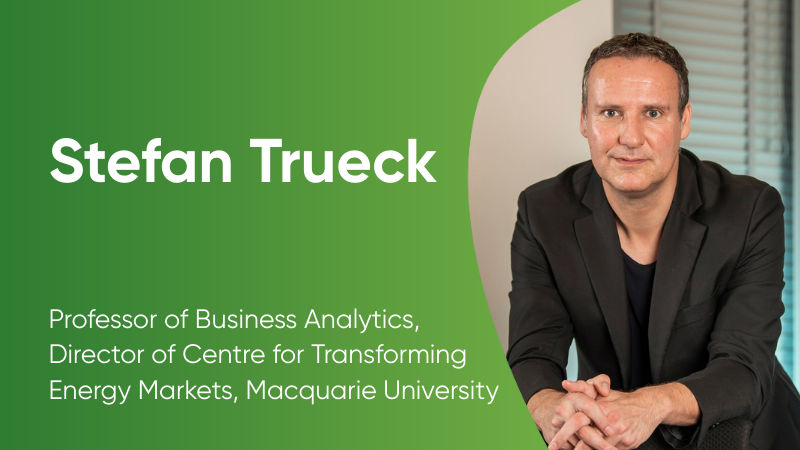
Stefan Trueck is a Professor of Business Analytics, the Director of Macquarie University’s Centre for Transforming Energy Markets and Co-Director of the Centre for Risk Analytics at Macquarie Business School. Stefan is also an ACS member who kindly took the time to share his research into renewable energy solutions of wind farms and the very real challenge of wind droughts and their impact on the market.
1. Tell us about yourself and why this area of research means so much to you.
Stefan: My research focuses on how data, markets and technology shape the transition to cleaner energy systems. I am particularly interested in understanding risk, uncertainty and system behaviour as electricity systems become more decentralised, digital and weather-dependent. This area matters to me because sustainability is ultimately a systems problem: it requires reliable infrastructure, trustworthy market design and intelligent use of data and analytics. If we get this wrong, cleaner technologies can create new vulnerabilities. If we get it right, they can deliver resilience, productivity and long-term economic value.
2. Can you summarise your research project or outline your thesis statement?
Stefan: This research project looks at wind droughts—periods when wind generation stays unusually low—and why they matter for electricity markets. Using high-frequency data from Australia’s National Electricity Market, we show that even with massive investment in wind farms, these droughts still occur and are becoming more expensive. When wind output drops during peak demand, electricity prices can spike sharply, creating reliability and cost risks. The key insight is that building more renewables alone is not enough. Smarter system design, storage, transmission and data-driven planning are essential.
3. What inspired or triggered this line of research? Was it a real-world incident, a technology gap, or a collaboration with partners?
Stefan: This research was triggered by a growing gap between how renewable systems are often planned and how they behave in the real world. Internationally, countries like Germany and Spain have experienced major system stress during so-called Dunkelflauten, where low wind and solar output coincided with high demand, increasing blackout risk. In Australia, similar concerns emerged during recent market crises, when tight supply and weather variability led to extreme prices and reliability warnings. These events highlighted a technology and data gap: we were planning for averages, not extremes. That insight, combined with industry and policy engagement, motivated this research.
4. What exactly are you and your team developing, and how does it differ from or improve on current approaches in the field?
Stefan: The team is developing a data-driven framework to measure, rather than assume, the reliability of wind-dominated electricity systems. Unlike most existing studies, which rely on simulated weather data or average capacity factors, we use high-frequency operational data from every wind generator in Australia’s electricity market. This allows us to show, for the first time, that wind drought risk has only marginally declined despite large capacity expansions, and to directly quantify the economic cost of these droughts through their impact on wholesale prices. This approach moves the debate from theoretical adequacy to measurable, market-relevant risk.
5. Looking ahead, what are the next steps or opportunities for this research, and how might ACS members get involved?
Stefan: Looking ahead, the research will expand to examine how batteries, long-duration storage and emerging technologies like offshore wind can reduce the risk and cost of wind droughts. Offshore wind offers higher and more stable capacity factors and different weather correlations, making it a powerful complement to onshore renewables. Advancing this work requires sophisticated data platforms, forecasting, optimisation and digital system design. ACS members can contribute through expertise in AI, software engineering, digital twins, cyber-physical systems and market platforms. Designing technology that coordinates generation, storage and markets reliably will be central to Australia’s clean-energy future.
Want to learn more about wind droughts? Or have an opinion on Stefan’s research? Join the conversation on LinkedIn.
Join ACS to access conversations, events and tech communities making real change with impactful solutions.