

From sustainable concepts to scalable action
For ACS, March is Clean Tech Month, a time to spotlight conversations around cleaner technologies, sustainability, and the role technology can play in addressing environmental challenges.
Sustainability is now a core technology, productivity and risk-management challenge for every organisation. As digital systems, data and AI continue to scale, the ability to design and operate technology responsibly will be a defining capability for Australia’s tech profession.
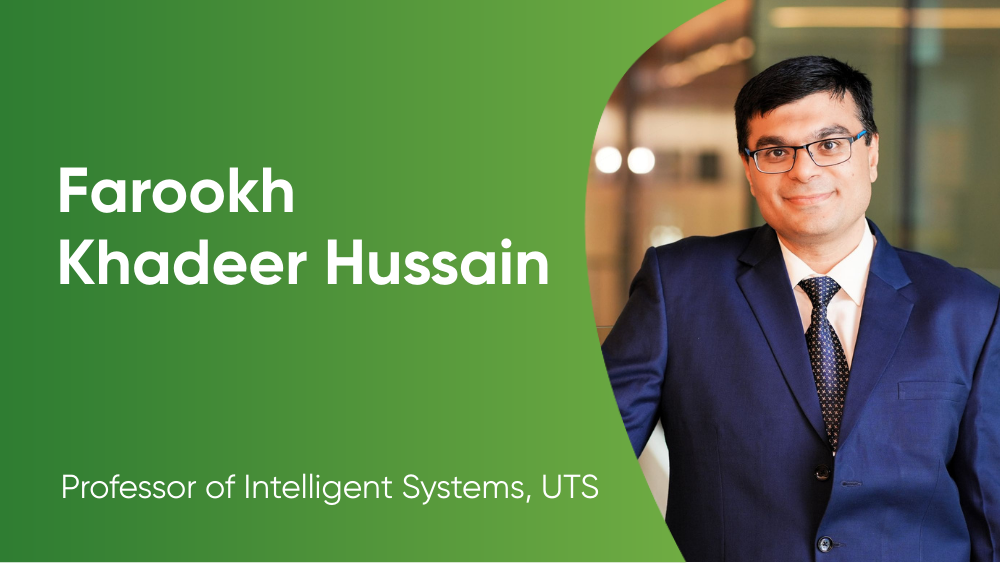
Farookh Khadeer Hussain is a Professor at the University of Technology Sydney in the School of Computer Science and the Australian AI Institute, an ACS member, and a widely recognised researcher in business intelligence, cloud computing, software engineering and AI applications. His work is distinguished by a consistent focus on translating advanced research into real-world impact, thereby delivering scalable solutions across agriculture, manufacturing, healthcare and transportation. Here, Farookh discusses his passion for bridging the gap between research and industry, and his platform that verifies the authenticity and quality of carbon credits.
1. Tell us about yourself and why this area of research means so much to you.
I am a Professor of Intelligent Systems at the University of Technology Sydney, where I work across the School of Computer Science and the Australian AI Institute. My career has been built on a single conviction: that advanced research truly matters only when it leaves the lab and solves real problems. That philosophy has shaped everything I do—from the projects I take on to the industry partnerships I build.
My applied research spans agriculture, mining, manufacturing, healthcare and transportation. These are sectors where technology can meaningfully reduce environmental impact at scale. Over the past several years, my team has developed and commercialised cutting-edge tools that help organisations operate more responsibly while delivering measurable environmental and economic benefits.
Climate change is, without question, one of the most urgent challenges facing society today. But urgency alone does not produce solutions; rigorous engineering does. I believe technologies such as AI and blockchain, when designed and deployed thoughtfully, can play a critical role in building the sustainable systems our economy needs. What drives me is the opportunity to work at that intersection, where deep technical capability meets genuine environmental and commercial need. Australia, with its resource-intensive industries and ambitious sustainability targets, is precisely where this kind of applied research can have the greatest impact.
2. Can you summarise your research project?
The thesis that underpins all of our work is straightforward: sustainability solutions succeed only when they are engineered to the same standard as any enterprise-grade system: reliable, scalable, and verifiable. Too often, sustainability technology stops at the proof-of-concept stage. Our research is deliberately designed to cross that gap.
We develop technology-driven sustainability solutions that solve practical environmental problems across industries, including agriculture, mining and manufacturing. Our focus is on creating deployable tools, based on novel theoretical models, that organisations can integrate into their existing operations to improve efficiency, transparency and environmental performance.
A flagship example is our AI and blockchain-powered platform for carbon-credit verification. The carbon credit market is critical to Australia’s net-zero ambitions, yet it faces a fundamental trust problem. Greenwashing, where organisations claim environmental credentials that cannot withstand scrutiny, remains one of the most significant threats to the credibility of carbon markets globally. The lack of practical, scalable solutions to detect greenwashing and verify the integrity of carbon credits has eroded confidence among buyers, regulators and the public alike. Without that trust, the entire mechanism that carbon markets rely on to drive genuine emissions reduction is undermined.
Our platform is designed to address this problem directly. It verifies the integrity and provenance of carbon credits in real time, giving businesses the confidence that every credit they purchase or retire represents a genuine, measurable environmental outcome rather than a mere paper exercise. The AI layer analyses project data, assesses credit quality and flags indicators of greenwashing, while the blockchain layer provides an immutable, transparent audit trail that makes manipulation practically impossible. It is a combination that neither technology could achieve on its own. AI provides the intelligence to evaluate quality, and blockchain provides the trust architecture to guarantee transparency.
But carbon credit verification is one application of a broader research agenda. Across every project, the principle remains the same: develop advanced technologies with deep industry collaboration to transform sustainability from aspiration into measurable, scalable action.
3. What inspired or triggered this line of research? Was it a real-world incident, a technology gap, or a collaboration with partners?
Honestly, it was the combination of all three factors, and they reinforced each other over time.
The urgency of climate change is the backdrop to everything we do, but urgency alone did not shape our research direction. What shaped it was a pattern I kept encountering across industries. Through my work with partners in agriculture, mining, manufacturing and other sectors, I saw the same disconnect again and again: organisations had genuine sustainability ambitions, but the technological tools available to them were either too immature, too theoretical or too disconnected from their operational realities to deliver meaningful results. The intent was there. The engineering was not.
That gap between ambition and execution is what triggered this line of research. I realised that the missing piece was not more research papers or more pilot studies, it was production-grade technology that could be embedded into real business processes and deliver verifiable outcomes at scale.
The carbon credit space crystallised this for me. Here was a market mechanism with enormous potential to drive genuine emissions reduction; yet it was being hollowed out by a lack of technological infrastructure to verify credit quality and detect greenwashing. Billions of dollars flow through carbon markets, but without robust, independent verification, buyers have no reliable way to distinguish high-integrity credits from worthless ones. That is not just a technology gap; it is a market failure with serious consequences for climate policy. The moment I understood the scale of that problem and recognised that the combination of AI and blockchain could address it in a way no existing solution could, the research agenda became clear.
Collaboration has been essential at every stage. This kind of translational research cannot be done in isolation. Working with industry partners has given us access to real operational data, real constraints and real feedback loops; all of which are indispensable for building solutions that actually work outside a laboratory. Some of the most important breakthroughs on our platform came not from algorithmic innovation alone, but from a deep understanding of how carbon credit supply chains actually function on the ground.
Rather than viewing sustainability as a constraint, our team sees it as one of the most significant opportunities for innovation of this generation. The organisations that invest in getting this right and the technologists who build the systems to support them will define how Australia and the world meet its environmental commitments.
4. What exactly are you and your team developing, and how does it differ from or improve on current approaches in the field?
One of our flagship developments is an end-to-end platform that verifies the authenticity and quality of carbon credits throughout their lifecycle, from generation through to retirement.
To understand why this matters, it helps to understand how carbon credit verification works today. The current approach is largely manual, periodic and fragmented. A carbon offset project, say a reforestation initiative or a methane capture programme, generates credits based on estimated emissions reductions. Those estimates are then reviewed by third-party auditors, often months or even years after the abatement activity has taken place. The verification reports are static documents. There is limited ability to detect whether conditions have changed since the audit, whether the claimed reductions are actually being sustained, or whether the same credit has been counted more than once across different registries. For buyers, this means purchasing credits largely on faith, and that faith has been repeatedly shaken by high-profile cases in which credits were linked to projects that delivered little or no genuine environmental benefit.
Our platform fundamentally changes this model. It replaces delayed, manual verification with continuous, technology-driven assurance. The AI layer ingests and analyses project data, including satellite imagery, sensor feeds and operational records, to assess whether the claimed carbon abatement is real, additional and sustained over time. It applies quality scoring to individual credits and flags anomalies that may indicate inflated claims or greenwashing. The blockchain layer then records every verification event on an immutable, transparent ledger, creating a complete provenance trail for each credit that any stakeholder, whether buyer, regulator or auditor, can independently inspect.
The critical differentiator is that these two technologies work as an integrated system. AI provides the analytical intelligence to evaluate credit quality at a depth and speed that manual auditing simply cannot match. Blockchain provides the trust infrastructure that ensures those evaluations cannot be altered, disputed or hidden after the fact. Together, they deliver something the carbon market has lacked from the outset: independent, real-time, tamper-proof verification.
The practical impact for organisations is significant. Buyers can make carbon credit purchasing decisions backed by verifiable data rather than static reports. Sellers of high-quality credits gain a mechanism to differentiate themselves in a market where quality has historically been difficult to prove. And regulators gain visibility into market integrity that current systems do not provide. In a carbon market projected to grow exponentially as Australia and other economies accelerate toward net zero targets, that kind of trust infrastructure is not a luxury; rather, it is a prerequisite.
5. Looking ahead, what are the next steps or opportunities for this research, and how might ACS members get involved?
The work we have discussed today, carbon credit verification, is just one example of what becomes possible when advanced technologies are applied to sustainability challenges with genuine engineering rigour. But here is what excites me most about the road ahead: the same approach, the use of advanced technologies such as AI and blockchain, can be applied to virtually any sustainability challenge that Australian businesses face today.
And there are many. Every industry in Australia is now confronting sustainability pressures, whether driven by regulation, investor expectations, customer demand or genuine environmental responsibility. Emissions monitoring, supply chain transparency, resource optimisation, environmental compliance, waste reduction, energy efficiency, circular economy transitions: these are not abstract research topics. They are operational problems that businesses need solved, and they need them solved with technology that actually works in production, not just in a slide deck.
That is exactly what we do. We partner with businesses as a team, combining our research capabilities in AI, blockchain, and intelligent systems with your industry and operational knowledge. We listen first, understand your specific challenge, and then co-develop a technology-driven solution engineered for your environment, your data, and your commercial reality. Every solution we build is designed to be deployable, scalable, and to deliver measurable outcomes, because that is the only standard that matters when real business performance and real environmental impact are on the line.
We are actively seeking new industry partnerships across every sector. It does not matter whether you are a large enterprise managing complex regulatory obligations, a mid-sized company looking to future-proof your operations against tightening sustainability requirements, or an innovative startup building the next generation of clean technology. If you have a sustainability problem and you believe technology should be part of the answer, we want to work with you.
What I can offer is something difficult to find elsewhere: a direct bridge between world-class university research and practical commercial delivery. You get access to cutting-edge AI and blockchain expertise, a team that has successfully commercialised sustainability technologies across multiple industries, and a collaborative partnership model where your problem drives the solution, not the other way around.
Australia’s path to net zero represents one of the largest technology opportunities of our generation. The businesses that move early and invest in building genuine, verifiable sustainability capabilities now will be the ones that lead their industries in the decade ahead. I want to help ACS members and their organisations be among them.
I encourage any business or ACS member reading this to get in touch with me at Farookh.Hussain@uts.edu.au. Whether you have a clearly defined project or simply a sustainability challenge you are not sure how to approach, start the conversation. Let us explore what we can build together.
Do you have an opinion on Farookh’s research? Join the conversation on LinkedIn.
Join ACS to access conversations, events and tech communities making real change with impactful solutions.