

Tech’s sustainability. How we all play a role
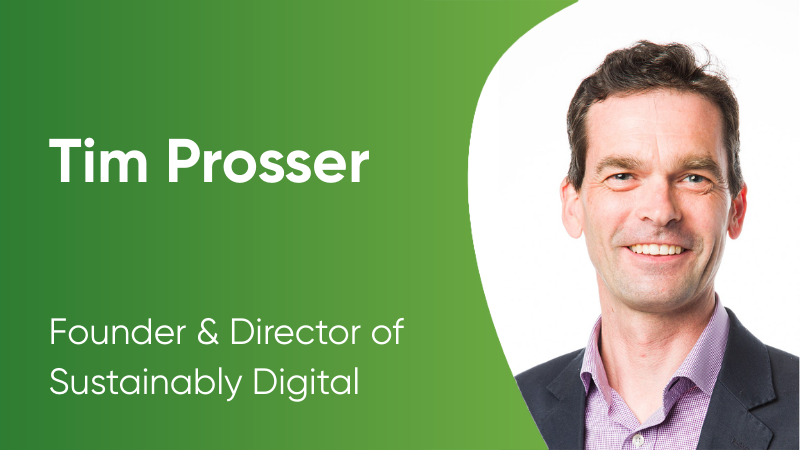
Written by Tim Prosser, Founder/Director at Sustainably Digital, this article suggests ways all tech professionals can contribute to sustainability by adopting simple, everyday behaviours.
Tech’s sustainability. How we all play a role.
As technology professionals, we often view our work as ethereal code living in the cloud, data streaming through the air. However, the physical reality of our industry is heavy. From the mining of rare-earth minerals for our devices to the gigawatts of electricity powering our data centres, the ICT sector currently emits 2 to 4% of global greenhouse gases, a figure on par with the aviation industry.
As ACS members, we are dedicated to championing the technologies powering Australia’s future. To do this responsibly, we must look beyond compliance and adopt a holistic framework for sustainable IT, distinguishing between three key impacts:
- The Footprint (Sustainability in IT): This is the direct negative environmental impact of our operations, which IT consumes, emits, or wastes. The goal here is to minimise harm.
- The Handprint (Sustainability by IT): This represents the positive enabling impact IT has on the world, using digital innovation to help other sectors reduce their carbon footprint.
- The Heartprint (IT for Society): This focuses on the human element using IT to bridge the digital divide, ensure accessibility, and improve societal well-being.
While large-scale corporate strategies drive the Handprint and Heartprint, individual tech workers, developers, sysadmins, and IT managers play a crucial role in managing the Footprint. You are the "boots on the ground" for sustainability.
Here are the top 10 practical actions you can take today to reduce your digital carbon footprint.
1. Extend the life of your hardware
The single most effective action you can take is to keep your devices longer. Research indicates that roughly 80% of a laptop’s total carbon footprint is generated during the manufacturing phase, long before you even turn it on. By extending a laptop’s refresh cycle from three or four years to five years, we can amortise that ‘embodied carbon’ over a longer period, reducing annualised emissions by approximately 20% to 33%.
Action: Resist the urge to upgrade for minor performance gains. Repair and refurbish instead of replacing.
2. Practice ‘Green Coding’ and the ‘3Rs’
Bloated software requires more processing power, which consumes more electricity. Sustainable software engineering focuses on writing energy-efficient code. We can apply the ‘3Rs’ of sustainable software:
- Relocate workloads to green regions
- Right-size resources to actual demand, and
- Re-architect to eliminate technical debt
Part of re-architecting involves selecting the right language for the job. Research into the energy efficiency of programming languages highlights distinct differences:
- Top Performers: Compiled languages like C, C++, and Ada are consistently ranked as the most energy-efficient. Among object-oriented languages, Java ranks highly when optimised.
- Interpreted Languages: Scripting languages such as Python, Ruby, and JavaScript tend to consume significantly more energy for the same tasks.
Action: Optimise algorithms to reduce complexity and remove ‘dead code’. While you may not always be able to switch languages, ensure you are using optimised libraries - it is possible to write efficient code in a scripting language, just as it is possible to write inefficient code in C++.
3. Delete ‘Dark Data’
We are creating data at an exponential rate, expected to exceed 180 zettabytes in 2026. Much of this is ‘dark data’, single-use data that is stored but never accessed again. Storing this data on servers consumes electricity, water and generates heat 24/7.
Action: Implement data hygiene. Delete old logs, duplicate backups, and unused environments. Treat data storage as a finite, carbon-costly resource.
4. Be ‘Carbon Aware’ with Cloud workloads
Not all cloud regions are created equal. The carbon intensity of the energy grid varies depending on location. Running a workload in a region powered by fossil fuels can emit over 30 times more CO2 than running it in a region powered by hydro or wind.
Action: Use tools such as Electricity Maps or your Cloud provider’s dashboard to select low-carbon regions for your servers and heavy compute tasks.
5. Responsible AI usage
AI is a powerful tool, but it is thirsty. Training a single LLM can consume as much energy as 120 Australian households use in a year. Furthermore, AI queries can consume significantly more potable water and energy than standard search queries.
We must move toward ‘Green AI’ by using models that are fit-for-purpose rather than defaulting to the largest model available.
Action: Use SLMs (Small Language Models) such as GPT-4o mini or Gemini 2.0 Flash, which are optimised for speed and efficiency. Explore quantised and pruned models, which reduce precision slightly to save massive compute power.
Resources: Utilise tools like Hugging Face Optimum to evaluate model efficiency, or the Green Software Foundation’s tools to measure the software carbon intensity of your AI projects.
6. Optimise video conferencing
Video calls have replaced travel, which is a net positive, but they still carry a carbon cost. Studies suggest that turning off your camera during a call when it isn't necessary can reduce the environmental impact by up to 96%.
Action: Adopt an ‘audio-only’ default for large meetings where you are a passive participant, and close unneeded browser tabs during calls to reduce CPU load.
7. Manage power settings aggressively
It sounds simple, but ‘vampire power’ is a real issue. A desktop computer left on 24/7 consumes significantly more energy than one that sleeps or hibernates. In fact, a desktop can draw four times as much electricity as an energy-efficient laptop.
Action: Ensure your devices are set to enter sleep mode after 15 to 30 minutes of inactivity. Turn off monitors when away from the desk.
8. Demand circularity (The 9Rs)
Transitioning from a linear economy (take-make-waste) to a circular one is essential to handling the 62 million metric tonnes of e-waste generated annually. This involves the 9Rs framework:
- Refuse
- Rethink
- Reduce
- Reuse
- Repair
- Refurbish
- Remanufacture
- Repurpose
- Recycle
- Recover
Insight: Australia generates one of the highest levels of e-waste per capita in the world, with figures of 20kg to 22kg per person annually often cited, which is nearly three times the global average of 7kg.
Action: Avoid sending electronic devices to a landfill. Ensure end-of-life gear goes to a certified IT Asset Disposition (ITAD) provider who prioritises refurbishment and reuse over simple recycling.
9. Leverage your buying power
If you influence procurement, use it to demand transparency from vendors regarding their carbon footprint and supply chain ethics. Look for globally recognised eco-labels such as TCO Certified.
Action: Ask vendors: "What is the product carbon footprint (PCF) of this device?" and: "Do you have a take-back program?”
10. Become a sustainability champion
Sustainability is a team sport. Cultural change often starts with a few passionate individuals who ask questions and educate their peers.
Action: Following Swedish multinational Electrolux’s example by gamifying sustainability. Electrolux’s ‘Cloud Challenge’ created a challenge to see who could delete the most unused data. Educate your colleagues on the environmental cost of their digital habits.
As ACS members, we are the architects of the future. By minimising our Footprint, maximising our Handprint, and strengthening our Heartprint, we can drive meaningful change.
Let’s use Clean Tech Month to ensure our impact on the planet is positive.
Like this article and looking for more? Join ACS!
Additional reading
The CTO’s New Mandate: From Tech Enabler to Sustainability Orchestrator
Greener Bytes: Digital Sustainability Trends to Watch in 2026
Sustainable IT Playbook for Technology Leaders (2nd Edition)
The environmental sustainability of digital content consumption [Nature]
Useful weblinks