

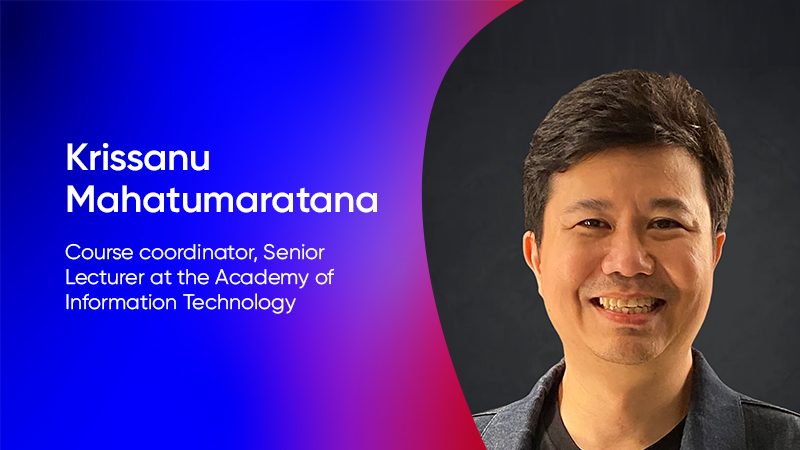
Conversation with Krissanu Mahatumaratana, Course coordinator, Senior Lecturer at the Academy of Information Technology
Improve your professional standing through ACS Certification.
As governments, businesses and the education sector become increasingly reliant upon technology, you face a new and fundamental challenge. A challenge that goes beyond keeping technical skills and knowledge up-to-date and demands that you prove your experience, leadership and professional capability in a way that employers, clients and peers recognise and trust.
That's where ACS Certification comes in.
ACS Certified Professional (CP) and Certified Technologist (CT) are independent, vendor-neutral professional certifications for technology professionals. Rather than testing what you've recently learned, ACS Certification recognises the capability, experience and professional practice you've already demonstrated throughout your career.
The ACS Certification assessment is based on the internationally recognised SFIA (Skills Framework for the Information Age) benchmark. It acknowledges not only technical expertise, but also professional judgement, responsibility and a commitment to ongoing development.
For many professionals, the impact goes well beyond adding post-nominals after their name.
Certification provides independent recognition of years of experience, increases confidence, strengthens professional credibility and helps technology professionals stand out as trusted practitioners and leaders. It transforms experience into recognised professional standing.
The following conversation with ACS member Krissanu Mahatumaratana, Course coordinator, Senior Lecturer at the Academy of Information Technology, shows what that transformation looks like in practice.
Before you decided to pursue ACS Certification, where were you in your career, and what were you feeling?
Krissanu Mahatumaratana: Before deciding to pursue ACS Certification, I was working as a Technical Manager, overseeing all IT operations for the company’s Australian branch. My role included managing technical infrastructure, leading the local IT team, and ensuring alignment with business objectives, while reporting to the head office in Los Angeles. This position provided strong operational experience, but I recognised the need to grow beyond a purely technical management role.
At that time, I felt both comfortable and challenged. While the role aligned with my technical expertise, I began to feel stretched and occasionally stuck, particularly when handling recruitment responsibilities, which were new to me. This pushed me out of my comfort zone and highlighted areas for growth.
I realised I needed to strengthen my people management skills, especially in emotional intelligence, communication, and recruitment decision-making. Additionally, pursuing globally recognised certification became important to me, as it would support my professional credibility and open opportunities on an international scale.
What motivated you to take action and invest in ACS Certification?
Krissanu Mahatumaratana: What prompted me to take action was a gradual realisation rather than a single moment. As technology continues to evolve rapidly, I recognised the importance of keeping my skills current and relevant. At the same time, taking on responsibilities beyond my core technical expertise exposed gaps in my leadership skills and strategic thinking.
I also had a clear ambition to grow beyond my current role and eventually build my own business, which would require a broader and more advanced skill set. I understood that if I did not act, I risked falling behind in a fast-moving industry and missing valuable opportunities for both professional growth and long-term career goals.
What action did you take or opportunity did you grasp?
Krissanu Mahatumaratana: To become an ACS Certified Professional, I took a structured and goal-oriented approach to my professional development. I aligned my learning with SFIA (Skills Framework for the Information Age), focusing particularly on reaching Level 6 in the Change and Transformation category, while also pursuing AWS certification to strengthen my technical capabilities.
I maintained a consistent learning routine, dedicating approximately two hours each evening to study through platforms such as ACS Skillsoft, LinkedIn Learning, and Udemy. This allowed me to build both technical expertise and leadership skills in parallel.
Despite challenges such as financial constraints and the need to identify up-to-date, high-quality resources, I remained focused by selecting cost-effective and relevant learning opportunities. This continuous effort has supported my progression towards ACS Certification and reinforced my long-term goal of building my own business.
What was the outcome, what did you achieve, and how did you feel?
Krissanu Mahatumaratana: The impact of pursuing ACS Certification has been significant for both my professional growth and confidence. Initially, there was limited support available; however, over time, ACS has expanded its offerings to include conferences, workshops, masterclasses, digital content, and professional programs. These opportunities have been valuable in helping me stay current and continuously upskill.
Programs such as the Middle Managers Digital Leaders Transformation Session were particularly impactful, supporting my progression from Senior Lecturer to Senior Coordinator. They also strengthened my confidence in people management, leading to greater involvement in recruitment within my department.
Overall, this journey has reinforced that investing in my development was the right decision. By combining technical, business, and people management skills, I have advanced my career, expanded my professional network, and gained the confidence to begin building my own business alongside my full-time role.
What advice would you share?
Krissanu Mahatumaratana: To succeed in a highly competitive and rapidly evolving industry, continuous upskilling is essential, and it is never too late to start.
For those considering ACS Certification, my advice is to approach it with clarity rather than as a compliance task. Use it as a framework to assess your current capabilities, define where you want to go, align your development with SFIA levels and be honest about your skill gaps.
Stay consistent by dedicating regular time to learning and combining resources such as ACS programs, certifications, and practical experience. Equally important is developing not just technical expertise, but also communication, leadership, and people management skills.
Make the most of ACS networking opportunities, workshops, and events to broaden your perspective and build industry connections. Most importantly, be patient and intentional. Consistent effort over time will create meaningful impact and open new career opportunities.
Realising your professional ambitions with ACS Certification.
One of the most valuable aspects of ACS Certification isn't receiving the credential. It's the opportunity to pause and reflect.
In fast-moving technology careers, there's rarely time to stop and consider how much you've learnt, how your responsibilities have grown or where you want to go next. Projects finish, new technologies emerge, and careers evolve almost without notice.
ACS Certification creates that moment.
It encourages you to look back on the experience you've built, the challenges you've overcome and the impact you've made. It asks you to think not just about what you've done, but about the judgment, leadership and professional capability you've developed along the way.
For Krissanu, ACS Certification became a framework for identifying the capabilities he needed to achieve his ambition of becoming a stronger leader and, ultimately, building his own business.
By recognising where you are today, you gain greater clarity about where you want to go tomorrow. Career ambitions become more tangible. Professional goals become more achievable. Development becomes intentional rather than reactive.
In that sense, ACS Certification is more than recognition. It is an opportunity to take stock of your career, acknowledge how far you've come, and confidently set your sights on what comes next.
Many ACS members are eligible for ACS Certification without realising it. If you would like to consider becoming either a Certified Professional or Certified Technologist, speak to your local ACS branch manager or submit an application.
ACS Certification is exclusive to ACS members. To become an ACS member, visit the Join ACS page.