

The IT Service Desk: The Front Line of Modern Business Operations
The IT Service Desk plays a vital role in the success of modern organisations, underpinning reliable operations, secure systems, and productive workplaces.
From supporting day-to-day technology needs to enabling broader business initiatives, Service Desk teams bring together technical expertise, process discipline, and a deep understanding of how people use technology to get work done.
As the primary interface between technology and the business, the Service Desk helps translate complex systems into effective, dependable services. Through consistent delivery, strong communication, and continuous improvement, these teams build trust and ensure technology meaningfully supports organisational goals.
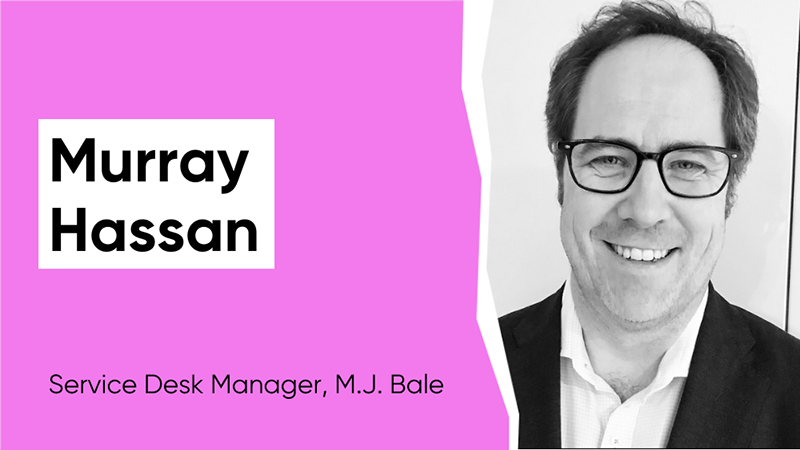
Beyond the tickets and the tech, there is a human element to every solution. We spoke with Murray Hassan, Service Desk Manager at M.J. Bale, to dig into how his team supports sales, empowers customers, and strengthens the entire business from the ground up.
1. How would you describe the role of the IT Service Desk within your organisation, and why is it so critical to day-to-day business operations?
Murray: The IT Service Desk in M.J. Bale is a part of the wider IT team, and functions primarily as a support service for stores and the head office team, but also as a first point of contact for any IT matters in general. It is critical for the retail part of the business, which often deals with time-sensitive issues; for example, if a staff member in store has a customer in front of them, and there is an EFTPOS error.
2. A service desk, often has to be running at all times, can you give an example of a time where your team were on the front line of solving an issue that may have gone un-noticed by the rest of the organisation?
Murray: Interesting question – most of the issues that arise in retail environments are visible and quite obvious to people. That said, one thing that the team solved that went under the radar was a random freezing of receipt printers. It turned out that we had a mix of drivers deployed, some being incompatible and outdated with the models in use. It was resolved with after-hours installs, to avoid any issues during store trade.
3. Can you share an example of a Service Desk improvement, transformation, or initiative that delivered measurable value to the organisation?
Murray: Thinking on this question, the most value was delivered from a simple troubleshooting document we created, to answer the most common questions. Our reasoning was that the simple issues faced at stores are often the most urgent, and if we offered a one-page guide to the most common urgent problems, it would empower the store teams to fix things quickly themselves, without the time taken to call the IT team. We always say to stores that this document is not about avoiding their calls, rather it is about giving them the fastest way to fix something.
4. Looking back, what’s a “quiet win” from the Service Desk that may not have been widely visible, but significantly improved how the organisation operates or experiences technology?
Murray: If I consider the overall organisation of M.J. Bale and not just stores, I think a “quiet win” from the Service Desk was the consistency of contact. We made conscious choices to engage both stores and office team members proactively. A Service Desk is often structured for reactive situations – waiting for the ticket or the call. We have spent some time calling and emailing store teams, store managers, and speaking with the support office team members regularly, so that we are aware of what is happening in their areas. It has never been something we announce or make noise about, but it is a part of our culture. We are now seen as more than just “the IT team”.
5. How do you develop, mentor, and retain high-performing Service Desk professionals in what can be a fast-paced and high-pressure environment?
Murray: Developing and mentoring any professionals, whether Service Desk or others, is about creating space in the busyness and pressure of issue-driven situations. The space to ask questions, to have conversations, and to go beyond the day-to-day matters. I want to know what my team wants to learn, and will find ways to get them involved in things. That keeps people engaged, interested and hopefully they see that there is more than just tickets and calls to a Service Desk; it should be about relationships and people, and how they relate to technology.
6. For someone considering a career in IT through the Service Desk, what skills, mindsets, or experiences will set them up for long-term success and growth?
Murray: I subscribe to the “three-legged chair” concept, borrowed/stolen from a past manager I had:
- One leg is technical ability; being able to understand the technologies in use.
- Another leg is problem-solving skills – how to identify and logically pull apart a problem to find a solution.
- The third leg is communication: it’s all well and good to have the technical knowledge, and to be able to problem-solve, but this is about dealing with a person reporting an issue. There is a need to explain the situation and solution simply and effectively – no more info than is needed, but no less – this isn’t magic, it is technology.
All three of these skills are vital for anyone seeking long-term success and growth in Service Desk roles and beyond.
---
Our discussion with Murray highlights just how critical the IT Service Desk is to a high-stakes retail environment. When teams lead with a proactive mindset, moving beyond the ticket to address root causes and skill gaps, they evolve into true business partners. Whether silently resolving hardware conflicts after hours or empowering store staff with self-service tools, they become the foundation that allows every other part of the brand to shine.
Not a member of ACS? Join us today for more exclusive industry insights, events and publications.