

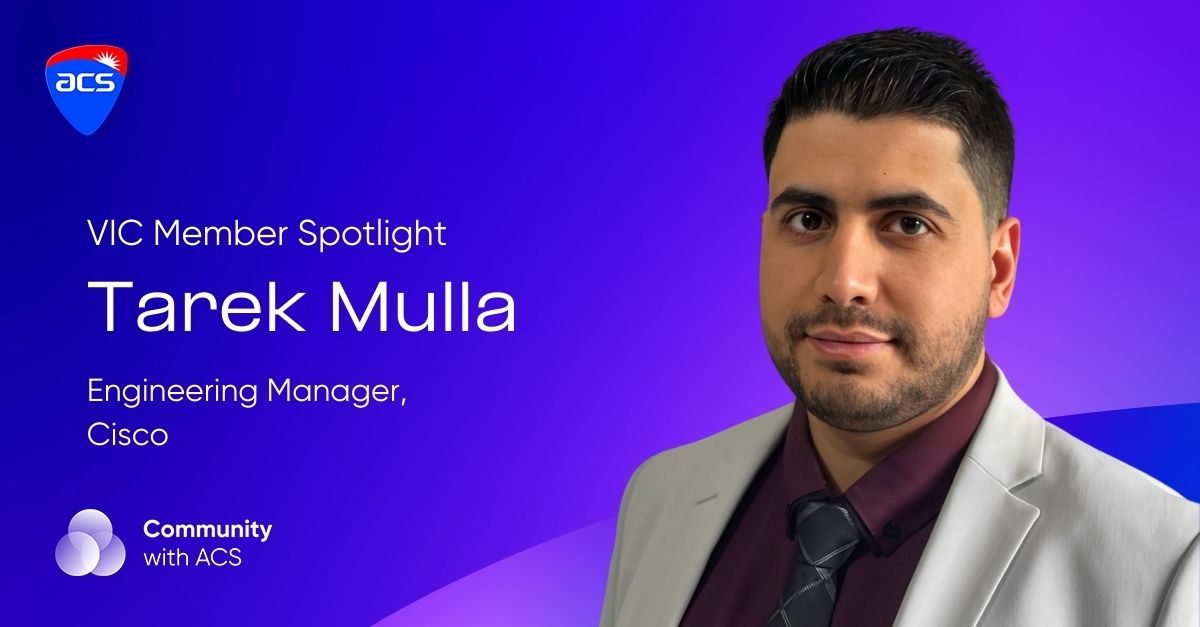
Victoria Member Spotlight: Tarek Mulla, Engineering Manager, Cisco
Tarek Mulla is an Engineering Manager at Cisco, where he leads a Site Reliability Engineering team responsible for supporting Duo Security, Cisco’s identity security and multi-factor authentication platform. After spending a decade working as a software engineer, he recently transitioned into leadership, bringing a strong technical background and a focus on supporting engineers to grow and succeed. In this Member Spotlight, he reflects on his move into engineering management, the qualities that underpin high-performing teams, and how mentorship and strong fundamentals help shape the next generation of engineers.
Can you tell us about your current role and what your day-to-day responsibilities look like as an engineering leader?
I'm an Engineering Manager at Cisco, leading a Site Reliability Engineering team responsible for Cisco's Identity Security and MFA solution called Duo Security. My day involves project planning, team check-ins, stakeholder alignment, and making sure engineers in my team have everything they need to do their best work. I also oversee our on-call operations to ensure our product stays reliable and available for our customers.
How did your career path evolve into engineering management?
I recently made the transition into Engineering Management after 10 years as an individual contributor; a journey that gave me a good technical foundation. Over time, I found myself naturally drawn to coaching teammates, leading projects, and solving people and process challenges. When a leadership gap emerged on my team, I stepped up and proactively started building the skills needed for the role. I also enrolled in an MBA to support that growth; I am very much at the beginning of this leadership journey, and I want to make sure I'm doing it properly.
What has been one of the most rewarding initiatives or projects you’ve led so far?
Any project that exposes me to new areas or tools is rewarding; I'm driven by learning. But if I had to pick one thing, it is the cultural side of leadership: building an environment where engineers feel supported and trusted to grow. Seeing someone gain confidence and own a complex problem is fulfilling.
What skills and leadership qualities do you believe are essential for building a high-performing engineering team?
Honesty and trust are the foundation. Beyond that, psychological safety, clear direction, and constructive feedback (both given and received) are critical. A high-performing team isn't just about individual talent; it is about how well people collaborate and how safe they feel to work together, speak up, take risks, and learn from mistakes.
How do you approach mentoring and developing the next generation of engineers?
I start by understanding each person's background and where they are in their journey. The pace of change in our industry is overwhelming (even for experienced engineers) so for those just starting out, it can feel like drowning in tools, technologies, and frameworks. My approach is to help them cut through the noise, focus on strong fundamentals, and develop the problem-solving mindset that makes any technology learnable.
How did you first become involved with ACS, and what do you value most about being a member?
My first interaction with ACS was when I migrated to Australia seven years ago; I went through the ACS Migration Skills Assessment as part of my visa process. I've been a member ever since. What I value most is the professional recognition from a respected industry body, and the sense of being represented within the Australian tech community. The ACS network is generous with knowledge-sharing, and staying connected to the broader technology landscape here has been really valuable to me.
What trends or shifts in the technology landscape are most exciting or impactful from your perspective?
Obvious, it is AI! AI is changing everything, the way we write code, think, and solve problems. I'm excited about what it can do, but I also think we need to be careful and thoughtful about how we use it. At the end of the day, AI works best when it helps people do better work, not when it replaces them.
What advice would you give to engineers who aspire to move into leadership roles?
Speaking as someone who has just made that transition; understand what leadership actually means before you chase the title. It's responsibility before anything else; it's about serving your team and the people who depend on you. Start building those skills early: mentor others, lead projects, communicate across teams. It won't always be easy, and I'm still learning every day, but it's already one of the most rewarding things I've done, both professionally and personally.