
Seeing the world in sound
How an entrepreneur's family crisis sparked a revolution for the blind
When Robert Yearsley pivoted his career in 2017, it wasn't because of a market gap analysis or a venture capital pitch. It was because life intervened in the most personal way possible.
Yearsley, a serial tech entrepreneur with four companies under his belt and a résumé spanning digital video recording, tablets, and collaboration platforms, was living in San Francisco with his wife, also a seasoned founder, and quietly planning their next AI startup. Then one of their children experienced a sudden, profound disability. Everything changed overnight.
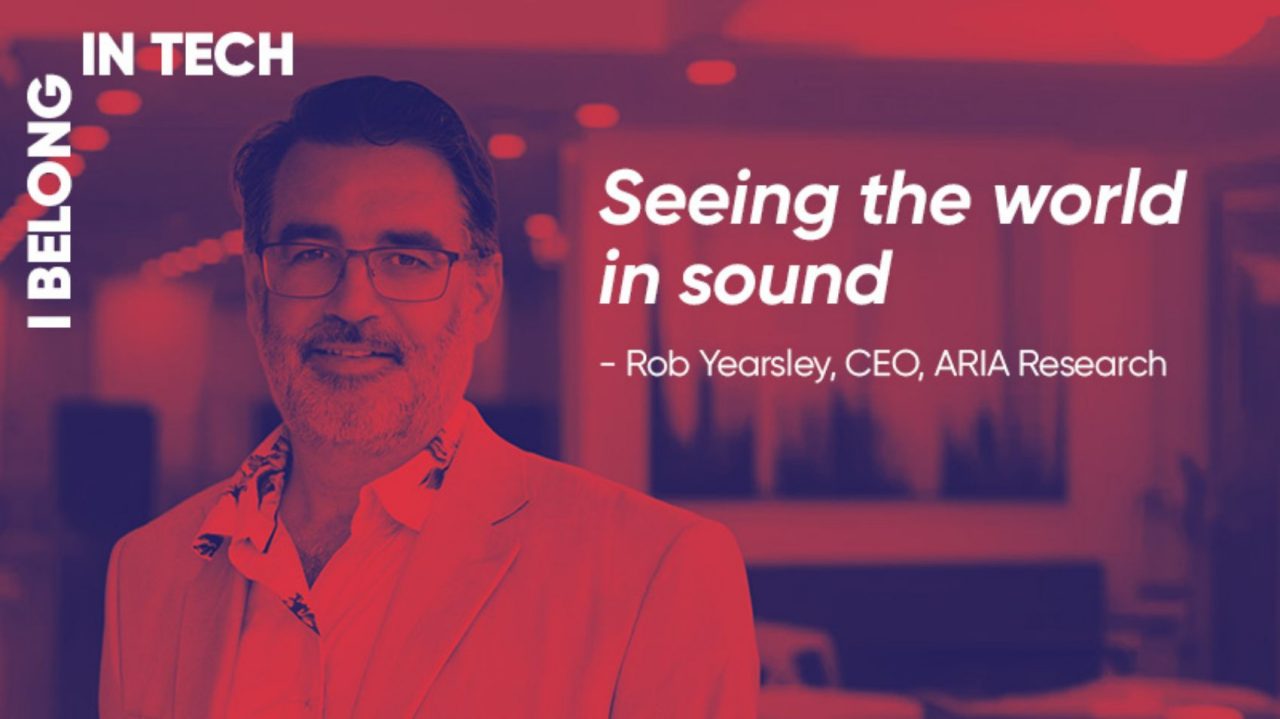
"It defined how we spent our time, defined how we spent our money, it defined our relationship with each other and our family," Yearsley recalls. The experience left him, by his own admission, a complete newcomer to the world of disability. But it also handed him a lens that most tech entrepreneurs never get: the visceral, first-hand understanding that the people who need technology most are often the least served by it.
The insight became the seed of Aria Research, a company that Yearsley co-founded in 2019 with fellow Silicon Valley serial entrepreneur (and his best friend and the godfather of his son) Mark Harrison. What has emerged may be one of the most genuinely transformative assistive devices ever built: augmented reality glasses for blind people that render the wearer’s visual surroundings as three-dimensional, spatialised surround sound. In essence, what Aria Research has created is Vision via Sound for the Blind.
The solution hiding in plain sight
The device looks like an ordinary pair of sunglasses. What it does is anything but ordinary. The ARIA (“Augmented Reality In Audio”) device uses machine vision and spatial computing to build a real-time, three-dimensional model of the wearer's surroundings, then delivers that model back to the user as binaural 3D spatialised surround sound audio through tiny speakers embedded in the arms of the glasses. A glass on a table sounds like the iconic ‘tink’ sound of a glass being struck, and the sound appears to come from exactly the position the glass occupies. This principle is broadly applied, creating a rich, detailed and contextual sound representation of the immediate physical environment - door handle across the room, a conversation partner’s facial expressions, or open spaces through which to move.
For a blind person, the experience of ARIA fills in and expands their spatial perception, dramatically increasing accessibility to the physical environment. “Our blind colleagues, testers, and co-design collaborators have often described ARIA as providing them ‘foresight’, that allows them to easily glance around and immediately perceive a much larger context of what’s around them - well beyond the reach of touch or their cane - and make more relaxed, empowered decisions about where they want to go and what they want to do next,” says Yearsley.
The guiding philosophy behind this approach came directly from the blind community - Aria’s first employees and advisors were all blind. “From day one,” says Yearsley, “our blind colleagues told us, ‘You can't understand blindness by looking at it, only by having lived it. Follow our lead on what the solutions need to be, and we'll get us to where we need to go.” Yearsley calls this ‘The blind leading the visionary’.
“With co-design at the centre of our product development process, the global blind community was quickly able to tell us what the actual problems are that blind people struggle to overcome every day, and what they wanted us to deliver that would solve those problems,” explains Harrison, Aria co-founder and Chief Product Officer. “Guided by our blind collaborators, with our very first proof of concept device, we were already able to significantly exceed the real-world functionality of implanted bionic eye systems that have been in development for over 30 years at a cost of hundreds of millions of dollars. That was the big ‘ah-ha’ moment when we knew we were really on to something.”
“However,” says Harrison, “our blind colleagues made it clear that the rest of the team still had plenty to learn about bringing sighted assumptions to the table. The first was the common misconception that all blind folks have canes and guide dogs - completely wrong. It turns out nine out of ten blind people rely on another human being to navigate their world. Cane use sits around 10-11% of the blind population; guide dogs, only 6-7%. The rest depend on others, not by preference, but because the available tools aren't good enough.” Harrison continues, “And the consequences extend well beyond mobility. Social isolation, reduced independence, constant risk calculation before doing anything as simple as stepping outside - these are the daily realities that existing technology had barely dented, and this was the key burden the blind community was asking us to solve for.”
Building what nobody else would
What makes Aria's engineering approach distinctive - and challenging - is its ambition to be comprehensive. Rather than solve a single, narrow problem, which is the case with almost all assistive technology currently on the market, the team set out to give blind users something closer to continuous spatial awareness: the same fluid, real-time perception of surroundings that sighted people take for granted.
That's a very hard technical problem. Rendering a live, three-dimensional audio environment on a low-powered, all-day wearable device required deep expertise in spatial computing, machine vision, and audio engineering. Yearsley has assembled a team that includes people behind the technology of Dolby, Cochlear, and Magic Leap to tackle it.
The results have been striking. In Aria's first proof-of-concept trial, conducted remotely during COVID with a blind user in Manila named Marx Melencio, the device was pulled out of a shipping box, switched on, and immediately used to identify and reach for specific objects on a table - by someone with zero eyesight. That first field test, uncontrolled and unscripted, set the tone for everything that followed.
The business case for purpose
Today, Aria has completed pilot clinical trials with 11 blind participants, hitting primary safety endpoints and efficacy benchmarks. The company has raised approximately $10 million to date, mostly from programs like MTP Connect, including a recent $2 million investment from the New South Wales Medical Device Fund. ARIA has also been named Australian Technology Company of the Year and Australian MedTech Company of the Year, and recipient of the Australian Good Design Award for Medical Device Innovation. Despite these early successes, commercialising from Australia is far from certain. “The Australian investment ecosystem still hasn't built the muscle memory to back its own. The biggest challenge ARIA faces is raising local capital that will allow us to commercialise and export, rather than be forced offshore to make this happen,” says Yearsley.
The addressable market is significant - exceeding $100B globally. Australia's NDIS alone spends close to $2 billion annually supporting blind individuals. The United States Department of Veterans Affairs supports over 1.1 million blind veterans, and European health and disabilities systems cover over 10 million people with vision impairment. “With the NDIS, and its 24,000 or so participants with vision disabilities, Australia is the perfect place to launch ARIA,” says Yearsley. “However, Australia represents less than 1% of the world's blind population, so the opportunities for growth with expansion globally are tremendous, and we have already begun collaboration with some of these international partners.”
But when asked what success ultimately looks like, Yearsley doesn't cite revenue figures or market share. He borrows the answer from his blind colleagues instead. "The end goal isn't for ARIA to be something extraordinary," he says. "The end goal is mundanity. That one day, what ARIA does makes life more normal and a bit easier, so it can fade into the background as a given."
For entrepreneurs, it's a useful reminder: the best companies are often born not just from opportunity, but from necessity - and built not for an abstract market, but for the concrete needs of real human beings.
Those interested in learning more about ARIA, please visit the company website or contact ARIA CEO, Robert Yearsley.