

Inclusion in action: Turning intent into impact
This April, ACS is proud to celebrate Inclusion Month: a time to reflect on how we create environments where everyone feels heard, valued, and empowered to contribute.
As part of Inclusion Month, we sat down with ACS member Susan Sly, an executive technology leader with a diverse and non-traditional career journey spanning the Navy, oil and gas, and technology sectors. Susan’s relationship with ACS runs deep, with roles on the ACS National Diversity & Inclusion Committee and the Victorian Branch Executive Committee, and she walks the talk on inclusion, writing the inaugural strategy for Wheelchair Rugby Victoria with player contributions at the centre.
For Susan, inclusion is more than a principle; it is something we actively practise every day through our behaviours, decisions, and leadership. It is about moving beyond good intentions and ensuring that every individual has the opportunity to participate.
Susan has built her career across complex, high-performance environments and brings a practical, no-nonsense perspective to leadership, diversity, and inclusion. Her experience navigating different industries has shaped her strong belief that inclusion must be actively demonstrated, not passively supported.
While many organisations and individuals approach diversity and inclusion with good intentions, Susan highlighted that these efforts fall short if they are not translated into meaningful action: “There are an awful lot of things done with good intentions that may not necessarily have the appropriate effect,” said Susan. Leading her to highlight four actions that can help turn intent into positive impact.
1. Leaders set the tone
For Susan, leadership carries a clear responsibility to set and uphold standards: “The standard you walk past is the standard you condone,” is her mantra. Inclusive behaviour is shaped by everyday interactions, from who gets airtime in meetings and what the workforce looks like, to how leaders respond to challenging behaviour. In Susan’s experience, it’s important not to assume you know all the answers but to ask people what would make a difference. Equally, Susan urges leaders to demonstrate respect in their own behaviours and not to dismiss things as “politically correct”. Authenticity counts. Be aware of how behaviours impact others and don’t hold on to things just because you’re comfortable, and that’s how things have always been.
Addressing inappropriate tone or behaviour promptly and constructively is not being confrontational, but about ensuring a respectful and productive environment for everyone. “As a leader, you’re a role model, so be the person you want to see around you.”
2. Inclusion requires conscious choice
Susan acknowledged that speaking up is not always easy. There can be personal and professional risks in challenging the status quo, flagging that something needs to change or calling out a long-standing behaviour. “Being the ‘difficult’ one is hard…, but sometimes it’s who you have to be,” says Susan. We often hear “Oh, that’s just such-and-such”, but it’s not. The person probably doesn’t know their behaviour is impacting others, and tactfully calling it benefits them and everyone they interact with. Each of us decides how we show up when we see something that should change, whether we remain silent and leave it to someone else, or take action to support a more equitable outcome. As Susan summarises, “We all have a choice about who we are in the room.”
3. Take action in the moment
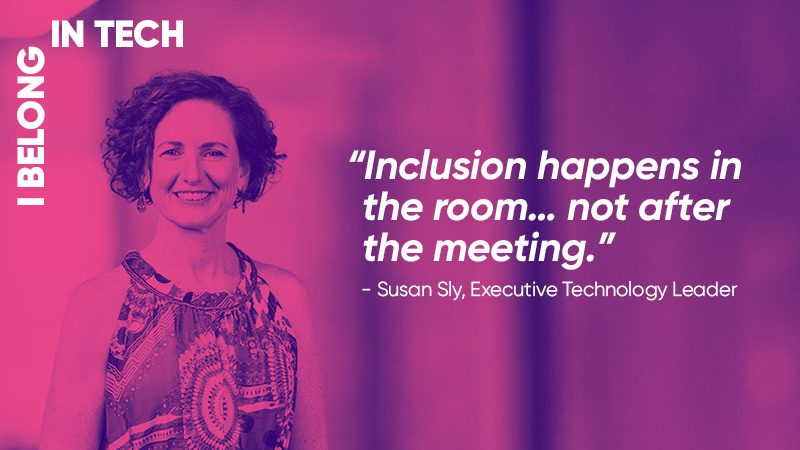
One of Susan’s most powerful reflections was the importance of addressing behaviours in the moment: “Don’t wait until later,” she says. “Speak up when it matters.” Susan described a common workplace scenario where someone is interrupted or spoken over in a meeting. Too often, colleagues offer support after the fact, checking in privately to see if the person is okay. Susan emphasised that while this behaviour is well-meaning, it doesn’t change the underlying dynamic. Instead, she advocates for real-time intervention: creating space in the moment for quieter voices to be heard and recognising everyone’s contributions as they happen. As Susan puts it, “Inclusion happens in the room… not after the meeting.”
4. Inclusion is a culture
Importantly, Susan framed inclusion as a collective responsibility. While leaders play a critical role in setting the tone, everyone in a team contributes to the culture. Small actions, inviting someone to share their perspective, changing something that stops someone participating, or calmly addressing exclusionary behaviour, can have a significant cumulative impact. Over time, these behaviours help build environments where people feel confident to contribute and where diverse perspectives are genuinely valued.
Throughout the discussion, there was a clear sense of optimism. Susan’s perspective is grounded in the belief that meaningful change is achievable when individuals are empowered to act. And importantly, she stresses that inclusive workplace cultures benefit everyone, not simply those previously excluded. By focusing on practical behaviours rather than abstract concepts, organisations can create inclusion that is visible, measurable, and sustained. Susan sums it up perfectly: “A work environment that broadens the diversity and capabilities of the workforce is an investment, not a cost.”
As ACS celebrates Inclusion Month, Susan’s insights provide a timely reminder that inclusion is not something that happens in policy documents or statements alone. It is built through everyday actions: in meetings, in conversations, and in the choices we make as colleagues and leaders. By committing to act in the moment and support one another, we can create a more inclusive and equitable environment for all.
Join our community and share your thoughts on inclusion by contributing to the conversation on our LinkedIn channel.