

The hidden inflation in your code: why "green" is your best financial hedge
10 Mar 2026 | By Cheng Yu, Head of R&D, Trellis Data
"Cost of living" is the phrase of the moment. But as we celebrate Clean Tech Month, I want to talk about the one variable that is about to blow a hole in your IT budget: The cost of electricity.
According to the PJM Interconnection (the grid operator for the world’s largest data center market), the price for capacity in their region jumped from roughly USD $28 to USD $269 between 2024 and 2025. That is a nearly 10-fold increase in a single year.
We tend to forget that Artificial Intelligence—for all its magic and promise—is, at its core, just software. It is code running on metal. And that metal is hungry.
The API Price Shock is Coming
We are currently building our digital economy on a reliance on foreign infrastructure. But the energy grids powering the world's largest data centre hubs are hitting a physical wall.
Forecasts show a massive tightening of reserve margins by 2027. Supply is struggling to meet the voracious demand of Generative AI.
Here is the uncomfortable truth: Skyrocketing electricity prices will inevitably turn into skyrocketing API prices.
If your business relies on a US-hosted LLM, you aren't just importing code; you are importing their energy inflation.
The Financial Hedge: Australian Electrons
So, how do we hedge this risk?
In finance, if you are exposed to currency fluctuation, you buy futures. You might ask: Why not just buy electricity futures?
The problem is that futures eventually expire. When the contract ends, you have to roll it over, and if the market is suffering from a structural physical shortage, you will be forced to buy at the new, astronomical price. Futures only delay the pain; they don't cure it.
Australian renewable energy is different.
Unlike gas or coal, which fluctuate with global markets, the "fuel" for a solar farm—sunshine—is free. When you utilize sovereign cloud infrastructure powered by renewables, you are effectively pre-paying for 20 years of fuel.
You aren't betting on the market price; you are exiting the volatility market entirely. You trade the chaos of the global grid for the stability of the local sun.
The Software Fix: Doing More with Less
But hedging the energy price is only half the battle. The other half is changing the software itself to consume less of it.
My research and development team at Trellis Data has been working on exactly this. We asked: Can we rewrite the inference stack to be more efficient?
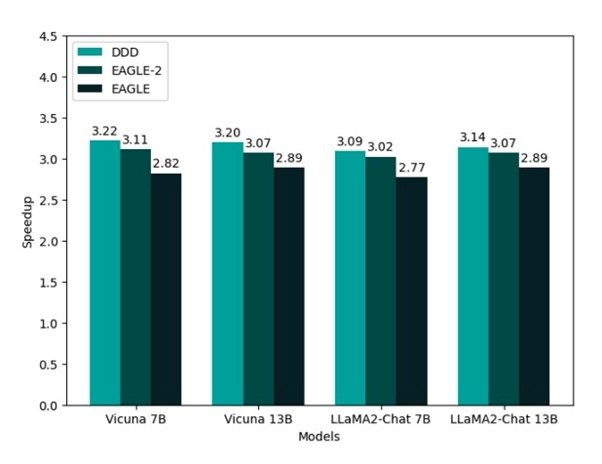
We released a paper on Dynamic Depth Decoding (DDD) so everyone can replicate that algorithm to save on energy.
Standard AI generates text one word at a time—a slow, expensive process. Our new method uses a "heuristic" (a real-time confidence check) to dynamically adjust how deep the model predicts into the future.
The results are good news for cost and environment:
- Speed: DDD achieves an average speedup of 3.16x over standard decoding.
- Efficiency: A 3x speedup means we can run high-intelligence models with a fraction of the GPU hours.
The experiments in the graph shows that it works across a variety of large language models.
ACS Canberra Team | E: acs.canb@acs.org.au